 Artificial Intelligence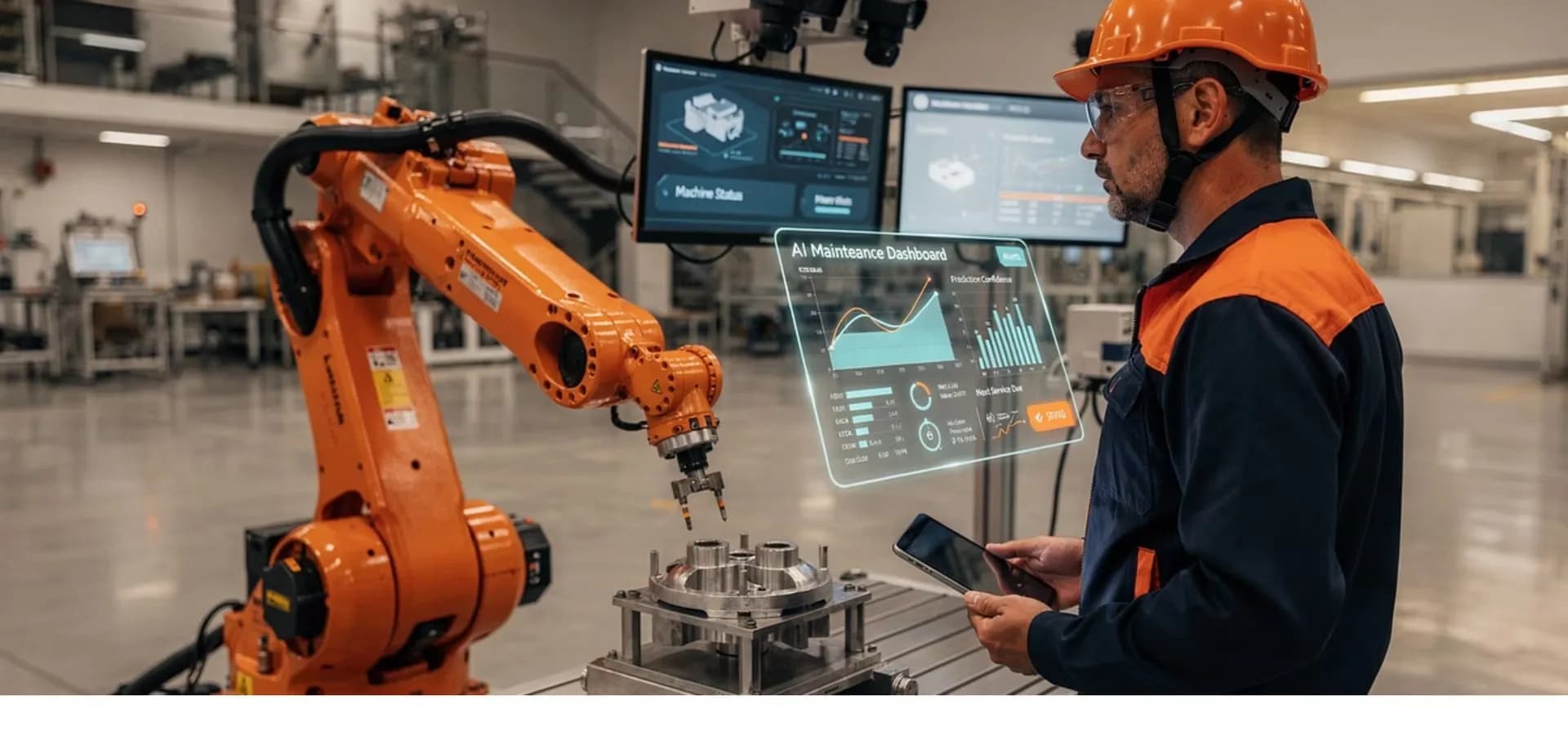
Artificial Intelligence
AI for business: how to apply it and what grants exist in 2026
BY TECNOCIM INNOVA PUBLISHED ON 23 MARCH 2026 · UPDATED ON
An estimated 6 in 10 companies in Spain will have adopted artificial intelligence by 2027 (El Español/Invertia, 2026). But adoption varies sharply with size: 58.2% of large companies already use AI, against only 21.1% of medium-sized companies and 3% of small ones (ONTSI/INE, 2024). 71% of European companies considering AI point to the lack of specialist knowledge as the main barrier. The opportunity for companies that move first is clear.
Real AI applications by business sector
AI is not a single technology: it is a set of tools applied differently depending on the sector and the process. These are the applications with the greatest proven impact:
Industry and manufacturing
- Predictive maintenance: algorithms that analyse sensor data to predict machinery failures before they happen. It cuts unplanned downtime by between 30% and 50%
- Visual quality control: machine vision systems that spot defects on production lines more accurately than the human eye
- Digital twins: virtual simulation of complete production processes, to optimise output, shifts and inventory before making real changes
- Production planning: algorithms that optimise the sequencing of manufacturing orders against demand, capacity and constraints
Logistics and supply chain
- Route optimisation: AI that calculates distribution routes in real time, factoring in traffic, priorities and vehicle capacity
- Demand forecasting: predictive models that anticipate demand by product, channel and geography so inventory can be adjusted
- Intelligent warehouse management: picking automation, dynamic product placement and predictive replenishment
Finance and administration
- Automatic bank reconciliation: AI that matches bank transactions against invoices and accounting entries with no manual intervention
- Fraud detection: algorithms that identify anomalous patterns in financial transactions
- Cash flow forecasting: models that predict cash movements more accurately than traditional methods
- Document automation: automatic extraction of data from invoices, contracts and documents with NLP (natural language processing)
Marketing and sales
- Personalisation at scale: campaigns that adapt automatically to each customer's behaviour
- AI lead scoring: models that rank sales contacts by their likelihood of converting
- Content generation: assisted drafting of sales copy, emails and proposals tailored to the recipient's profile
Do you want to deploy AI in your company? Request a free assessment and we will help you identify the applications with the greatest impact on your business.
What funding is available to deploy AI in your company?
The public funding ecosystem for AI projects in Spain is unusually generous in 2026:
| Programme | Amount | Type of aid | Profile |
|---|---|---|---|
| CDTI PID/LIC | From €175,000 | Loan + non-repayable element (10-33%) | R&D projects with AI |
| CDTI Cervera | €50M in total | Grant | Deep learning, AI, technology centres |
| Misiones IA | Variable | Grant | AI applied to health, agriculture, energy, employment, the environment |
| Kit Digital | €1,000 – €29,000 | Direct grant | AI tools for SMEs |
| Kit Consulting | €12,000 – €24,000 | Grant-funded consultancy | Identifying AI opportunities |
| Ticket Innova | Up to €7,000 | Grant | AI, automation, augmented reality |
| Cupons ACCIÓ Industria 4.0 | Up to €20,000 | 100% grant | Assessment + industrial AI rollout |
Complementary tax incentives:
- R&D&I tax deductions: applied AI development projects qualify as R&D (25-42%) or technological innovation (12%)
- Binding technical report (informe motivado): legal certainty for the deductions
- Social Security contribution reductions for research staff: 40-50% off the contributions of your AI team
Combining CDTI funding, tax deductions and Social Security contribution reductions can cover more than 60% of the total investment in an AI project.
How to deploy AI with a measurable return
The main cause of failure in corporate AI projects is not the technology but the lack of focus on a concrete business problem. To avoid it:
1. Identify the business problem, not the technology
This is not about "deploying AI" but about solving a specific problem: cutting delivery times, predicting demand, automating bank reconciliation. The technology is the means, not the end.
2. Start with a tightly scoped pilot
Pick one specific process with data available and a measurable outcome. The aim: prove ROI in 3-6 months before scaling. The Cupons ACCIÓ for Industria 4.0 (up to €8,000 for the assessment plus €20,000 for the rollout) are ideal for this stage.
3. Make sure the data is sound
AI is only as good as the data that feeds it. Before deploying models, check that the data is clean, complete and accessible. A well-implemented ERP (ERP guide) is the foundation of any AI project.
4. Train the team
AI training for the team matters as much as the technology. AI courses can be funded with the company's annual FUNDAE credit, like any other training linked to the business.
5. Measure and scale
Define KPIs before you start (time saved, errors avoided, sales gained) and measure after each phase. Only scale what proves a return.
Did you know that Kit Consulting offers up to €24,000 of AI consultancy for medium-sized companies? A specialist consultant identifies the AI opportunities with the highest ROI for your business. Find out more about AI for business →
What results can your company expect from AI?
Returns depend on the process being automated, but these are realistic benchmarks based on rollouts in Spanish companies:
| Application | Sector | Typical return |
|---|---|---|
| Predictive maintenance | Industry | 30-50% less unplanned downtime |
| Route optimisation | Logistics | 15-25% saving on transport costs |
| Document automation | Administration | 60-80% less processing time |
| Demand forecasting | Retail/distribution | 20-30% less excess inventory |
| Lead scoring | Sales | 15-25% higher conversion rate |
| Visual quality control | Manufacturing | 40-60% fewer undetected defects |
| Customer service chatbots | Services | 60-80% of queries handled automatically |
The average payback period on well-targeted AI projects is 6 to 18 months, and with the grants available — which can cover up to 60% of the investment — that payback shortens considerably.
In Catalonia, companies that combine Cupons ACCIÓ for the pilot stage with CDTI funding for full development gain a funding itinerary that runs from the assessment through to production rollout.
The time to act is now
The competitive window on AI narrows as more companies adopt it. In 2026, the Next Generation funds finance AI projects with a deadline of August 2026, and programmes such as the Kit Digital for AI in 2026 and CDTI are in full swing. Companies that act now reach public grants that may not be there in the years ahead.
At Tecnocim Innova we combine R&D&I consultancy with management of grants and tax deductions so that your company deploys AI with the highest possible financial return.
Do you want your company to make the most of AI with public funding? At Tecnocim Innova we work with you from spotting the opportunities through to managing CDTI funding, tax deductions and Social Security contribution reductions. Get in touch for a review with no obligation.
Related services
AI for Business
Practical AI training for your team: ChatGPT, Copilot, Gemini, Claude. Assessment, tailored programme and results...
View service →Automation with AI
Automate business processes with AI: intelligent workflows, autonomous agents and integration with your existing tools.
View service →Request a free assessment
Free assessment for companies with revenue above €500,000
Get grant and tax deduction updates by email
Calls, deadlines and regulatory changes, once a month.
ai for businessartificial intelligence for companiesbusiness automation with aihelp to apply ai in my business
Related articles
Artificial Intelligence Artificial Intelligence