 Regulation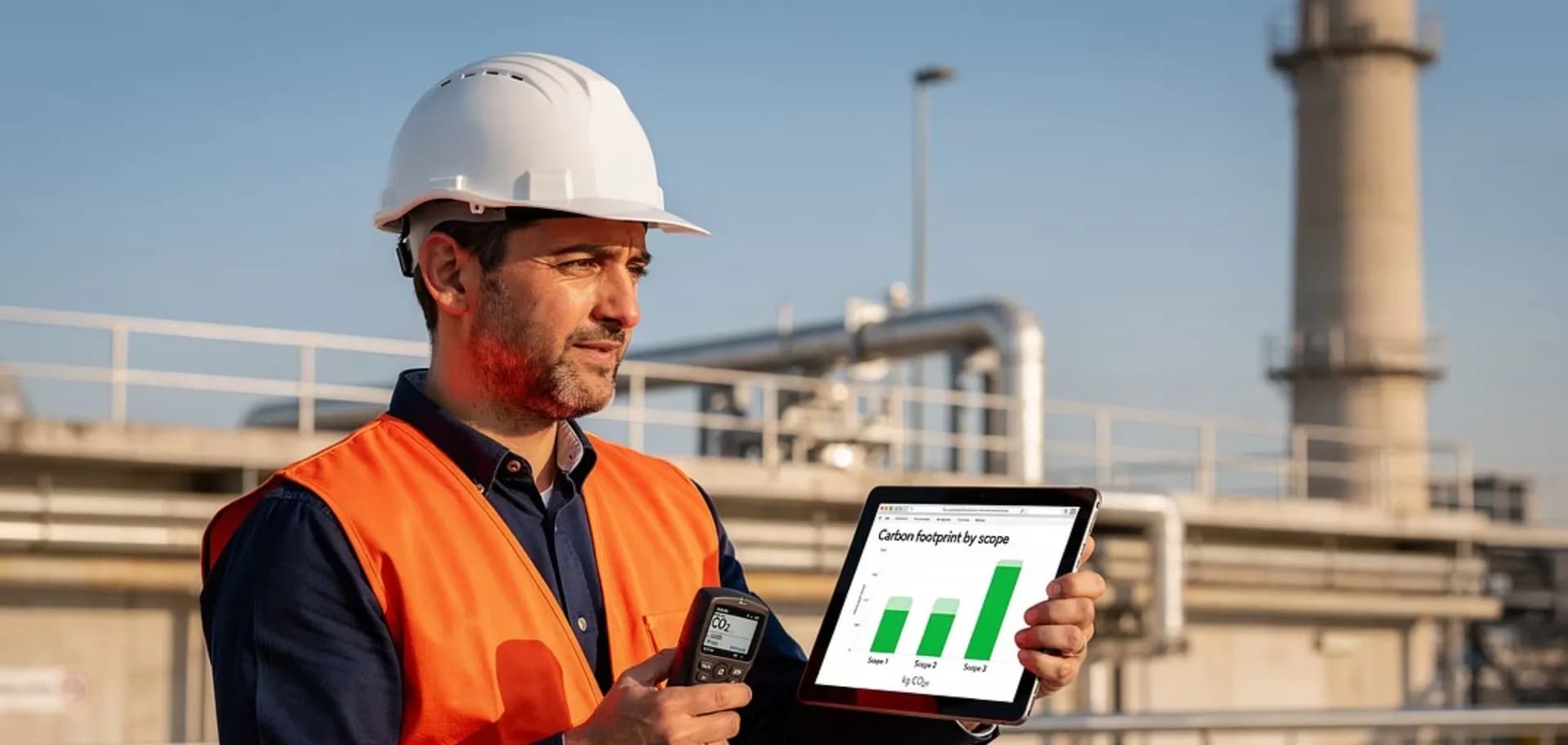
Regulation
Corporate carbon footprint in Spain: rules, registry, grants
BY TECNOCIM INNOVA PUBLISHED ON 23 MARCH 2026
Real Decreto 214/2025 (the Spanish carbon footprint decree) has triggered the obligation to calculate and publish the carbon footprint for certain Spanish companies, with 5-year reduction plans aligned with climate neutrality by 2050 (BOE-A-2025-7439). Registration in the MITECO register is still voluntary for most private companies, but the regulatory direction is clear: more and more companies will need to measure, reduce and report their emissions. And there are public grants worth more than €700 million to fund the transition.
Which companies must calculate their carbon footprint
RD 214/2025, in force since June 2025, sets out different levels of obligation:
Full obligation (calculation + reduction plan + publication):
- Companies subject to Ley 11/2018 (the Spanish non-financial reporting act): more than 250 employees meeting certain financial thresholds (total assets above €20M or turnover above €40M)
- Public interest entities with more than 500 employees
- The Spanish central government administrative sector (mandatory from 2026)
Voluntary registration (recommended for every company):
- Any company can register voluntarily in the MITECO Carbon Footprint Register
- Registered companies obtain an official MITECO seal they can use in their corporate communications
- Registration demonstrates environmental commitment to clients, investors and Spanish public authorities
Key dates:
- From 1 January 2026: the first footprint that can be registered covers the 2025 financial year
- Mandatory publication: within 6 months of the close of the financial year
- Reduction plan: a minimum 5-year horizon with quantified targets
Does your company need to calculate its carbon footprint? Request a free assessment and we will set out your obligations and the opportunities open to you.
How is a corporate carbon footprint calculated?
The calculation follows the GHG Protocol (Greenhouse Gas Protocol) methodology, the most widely used international standard. Emissions are classified into three scopes:
Scope 1 — Direct emissions (mandatory):
Emissions from sources controlled by the company: combustion in boilers, furnaces and company vehicles, industrial processes, refrigerant gas leaks.
Scope 2 — Indirect emissions from energy (mandatory):
Emissions associated with the electricity, steam or heat purchased and consumed by the company. They depend on the supplier's energy mix.
Scope 3 — Other indirect emissions (voluntary):
Emissions across the value chain: transport of raw materials by third parties, business travel, use of products sold, waste generated. It is the most complex scope, but also the most significant in emission volume for companies with long supply chains.
Basic formula:
Carbon footprint = Activity data × Emission factor
Activity data is the consumption (litres of fuel, kWh of electricity, kilometres travelled) and the emission factor converts that consumption into tonnes of CO2 equivalent.
Tools available:
- MITECO calculator: free, official, covering scopes 1 and 2
- PIMEC calculator: designed for SMEs and self-employed workers in Catalonia
- Private platforms: Dcycle, mihuellacarbono.com and others with advanced features for scope 3
How to register a carbon footprint with MITECO
Registration in the MITECO Carbon Footprint Register is free and handled entirely online:
- Calculate the footprint: scopes 1 and 2 as a minimum (scope 3 voluntary)
- Draw up a reduction plan: quantified 5-year targets with concrete measures to cut emissions
- Access the MITECO electronic register with a digital certificate
- Complete the application: company details, year calculated, methodology used, results by scope
- Attach the documentation: calculation report, reduction plan, supporting evidence
- Resolution: MITECO reviews and approves the registration and awards the corresponding seal
MITECO seals:
- "Calculo" seal (I calculate): for companies that have calculated their footprint
- "Reduzco" seal (I reduce): for companies that demonstrate a reduction against the base year
- "Compenso" seal (I offset): for companies that offset emissions through carbon absorption projects
These seals carry growing weight in Spanish public tenders, in the supply chains of large companies and in ESG certification processes.
Did you know that Cupons ACCIÓ Green funds 100% of the carbon footprint calculation for Catalan SMEs? Find out how →
Grants and public funding to reduce your carbon footprint
Companies that want to cut their emissions can draw on a substantial ecosystem of public grants in Spain:
PERTE for Industrial Decarbonisation (>€400M):
A call worth more than €408 million (planderecuperacion.gob.es, 2026) for measures such as replacing fossil fuels with renewables, electrifying industrial processes and carbon capture technologies. Aimed at manufacturing industry.
IDAE grants — Industrial Value Chain (€355M):
IDAE has launched €355 million to strengthen the industrial value chain for clean technologies, including energy efficiency and decarbonisation projects (IDAE, 2026).
Energy efficiency programmes (€500M FNEE):
The Fondo Nacional de Eficiencia Energética, the Spanish national energy efficiency fund, allocates €300 million to industry and €200 million to the services sector. Every energy efficiency improvement directly reduces the carbon footprint.
Cupons ACCIÓ Green (Catalonia):
ACCIÓ offers vouchers funded at 100% for carbon footprint calculation, water footprint and decarbonisation strategies in Catalan SMEs.
Related tax deductions:
If emission reduction projects incorporate technological innovation, they can qualify for R&D&I tax deductions of 12–42% on the expenditure.
How to build the carbon footprint into your company strategy
Measuring the carbon footprint is not only about meeting an obligation: it is a chance to cut costs, access funding and improve competitiveness.
Recommended steps:
- Calculate: measure the footprint with official tools or with support from accredited consultants
- Register: sign up with MITECO to obtain the official seal (a competitive differentiator)
- Reduce: roll out energy efficiency measures, renewables and process optimisation
- Fund: apply for PERTE and IDAE grants, Cupons ACCIÓ and Next Generation funds
- Communicate: build the results into ESG reporting, your corporate website and tender submissions
Companies with a MITECO seal and an active reduction plan have an advantage in Spanish public tenders that score environmental criteria, in the supply chains of large companies that require ESG reporting from their suppliers, and with investors who prioritise sustainability criteria.
Sectors under the greatest regulatory pressure on carbon footprint:
- Manufacturing industry: the main target of the decarbonisation PERTE and of the FNEE
- Transport and logistics: European directive on emissions reporting across the supply chain
- Construction and building: mandatory energy certification and refurbishment with Next Generation funds
- Agri-food: carbon footprint as a growing requirement in large-scale retail
- Hospitality and tourism: competitive differentiation through sustainability labels
The trend is irreversible: European legislation (CSRD, the green taxonomy) will progressively extend emissions reporting obligations to smaller companies. Registering the carbon footprint voluntarily now puts the company in a strong position for when the obligation reaches its segment.
In Catalonia, companies can combine the carbon footprint calculation (funded through Cupons ACCIÓ Green) with the ICAEN energy efficiency grants to fund both the assessment and the rollout of reduction measures.
Do you want to calculate and reduce your company's carbon footprint? At Tecnocim Innova we help you with the calculation, with MITECO registration and with managing the grants that fund your decarbonisation plan. Get in touch for a no-obligation assessment.
Related service
Request a free assessment
Free assessment for companies with revenue above €500,000
Get grant and tax deduction updates by email
Calls, deadlines and regulatory changes, once a month.
company carbon footprintcalculate company carbon footprintcorporate carbon footprintcarbon footprint register
Related articles
Regulation Regulation